
Turnkey O-Ring Installation Cell Is Taking Shape – Part 2
October 28, 2026How Would You Install 3 O-Rings on One Part?
We'd Just Install Them.
One Part, Three Identical O-Rings
TL:DR
AIS built an ASP-1 o-ring installation machine with a Variable Placement Module (VPM) that installs three identical o-rings onto one fixtured part. It installs from the bottom groove to the top, so an installed o-ring never gets in the way of the next. It runs 45 installs per minute, which works out to about 15 finished parts per minute. It's a standard ASP-1 at heart, customized for one application and designed to slot into an automated line.
Here's a fun one. You have a part with three o-ring grooves. Same o-ring in all three. Your volume is high enough that someone in a meeting has started saying "throughput" with a concerned face.
How do you get them on?
Most shops start with an operator with good thumbs, a drawer of homemade tools, and a quiet hope that nobody rolls a twisted o-ring into a groove. That works right up until it doesn't, which is usually around the time volume goes up.
Our answer was an ASP-1 paired with a Variable Placement Module.
For us, that's just another install.
Can One O-Ring Machine Install Multiple O-Rings on the Same Part?
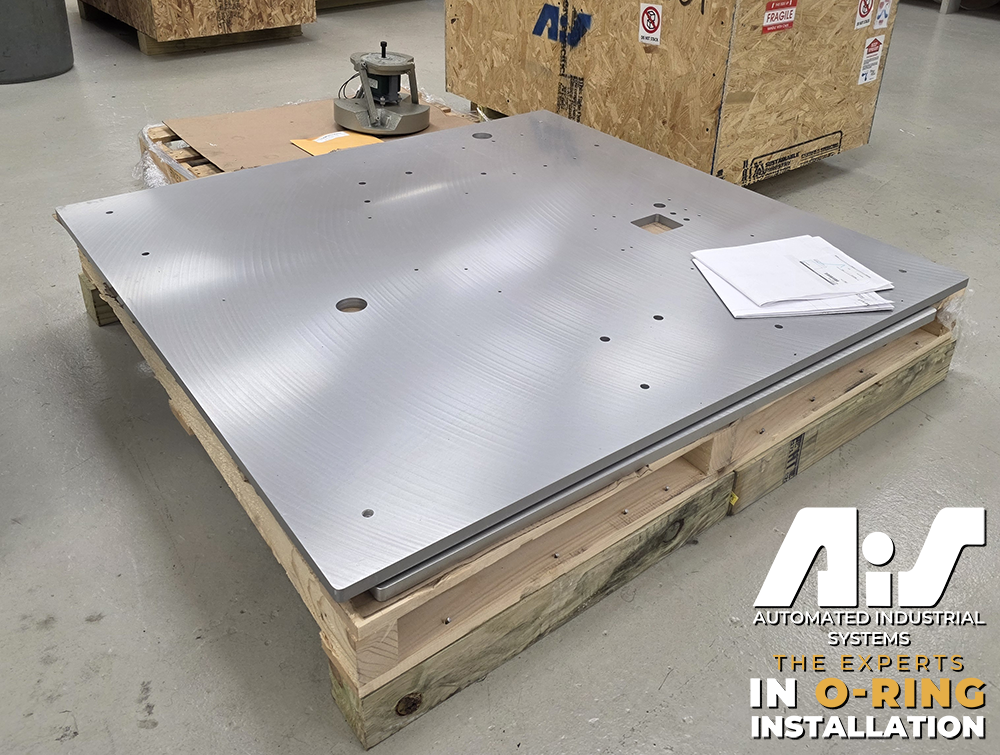
Yes. This machine installs three identical o-rings onto a single fixtured part. All three come from the same feeder bowl. The Variable Placement Module rotates 90 degrees downward to the part and controls install depth, so each o-ring lands in its own groove.
The order matters. The machine works from the bottom groove up, so an o-ring that's already installed is never in the path of the next one. It's a simple idea, and simple ideas tend to be the ones that still work on the millionth cycle.
How Fast Is It?
The machine runs 45 o-ring installs per minute. With three per part, that's roughly 15 finished parts a minute.
For comparison, Assembly Magazine reports that a skilled operator might install about 600 o-rings an hour, depending on the ring and the part. That's 10 a minute, assuming nobody needs coffee.
What Makes This Machine Custom?
At its core, this is an ASP-1, our workhorse external o-ring installer. It handles seals from 0.056" to 1.051" ID (1.42 mm to 26.70 mm), and tooling changes take less than 10 minutes.
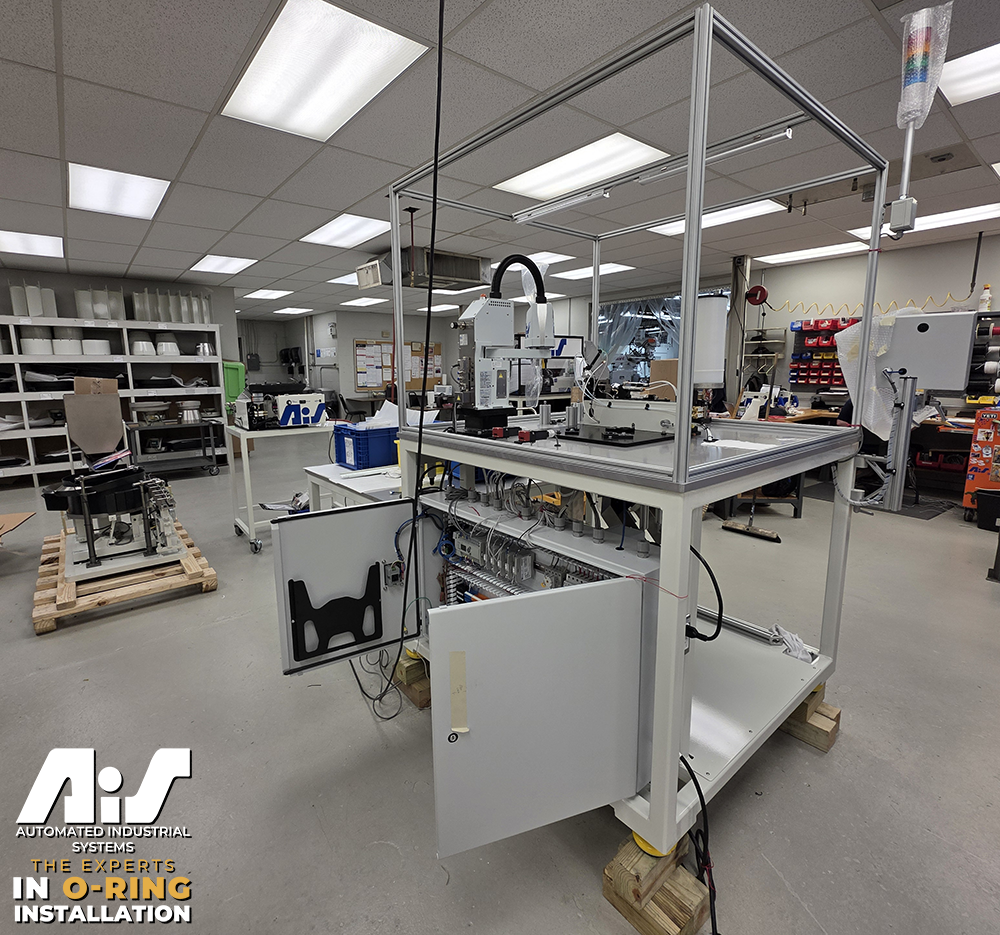
This application needed a few changes:
-
Variable Placement Module for placing at depth on a fixtured part
-
Control box mounted at the rear instead of in its standard position
-
Feeder bowl controller relocated outside its usual spot in the control box
-
Extended base plate
-
Part fixture built to the customer's specs, mounted on the extended base plate directly under the VPM
Everything else is stock ASP-1, and that's intentional. You get a platform with decades of production behind it, adapted to your part. It's not a science project, and you're not the first customer to run the code.
Where Is This Machine Going? Honestly, We Don't Know.
Look at it: rear-mounted control box, relocated controller, extended base plate, and a fixture sitting right under the VPM. It looks exactly like a station in someone's automated line. It was designed to slot into one.
Here's what we do know. The customer is tying into the machine's PLC to control it. That could mean their own foot trigger, or it could mean a larger robotic cell. And because the fixture sits under the VPM, something or someone has to load the part. Could be an operator. Could be a robot. The machine doesn't care, and where it ends up is the customer's business. Literally.
Do You Need Automation For an O-Ring Machine to Pay Off?
No.
An ASP-1 doesn't need a robot to earn its keep. The operator presents the part, and the machine expands and places the o-ring the same way every cycle. There's no thumb fatigue and no rolling.
According to Assembly Magazine, twisted o-rings won't seal correctly, and automated installation avoids that problem.
If you're installing o-rings by hand at any real volume, you're already paying for an o-ring machine. You're paying for it in labor hours, rework, and the occasional leak, and you don't get to own anything at the end.
How Long Will It Last?
Millions of cycles, for years. We regularly refurbish and rebuild AIS machines that are more than 20 years old. From a sales standpoint, we'd probably do better if we built them worse, but we've been at this since 1977 and we're not starting now.
(Technically we started with pad printing equipment in 1977. The first o-ring installer came in 1978. We've stuck with o-rings since.)
The Full AIS Line

Custom Hand Tools
Lightweight and easy to use, these tools are perfect for small, manual installations in tight spaces.

Semi-Automatic Systems
For higher-volume operations, the ASP, ISP and ARP lines can be easily integrated into your workflow.

Fully Automated Systems
When speed and precision are critical, our turnkey systems provide complete automation, minimizing downtime.
Got a Part That Makes You Ask "How Would We Even Do That?"
Send it to us. Odd geometry, multiple grooves, tight cell layout, or an NDA thicker than the part itself are all fine. Request a quote or find your rep.
Call us at 814-838-2270 or email info@aisoring.com.